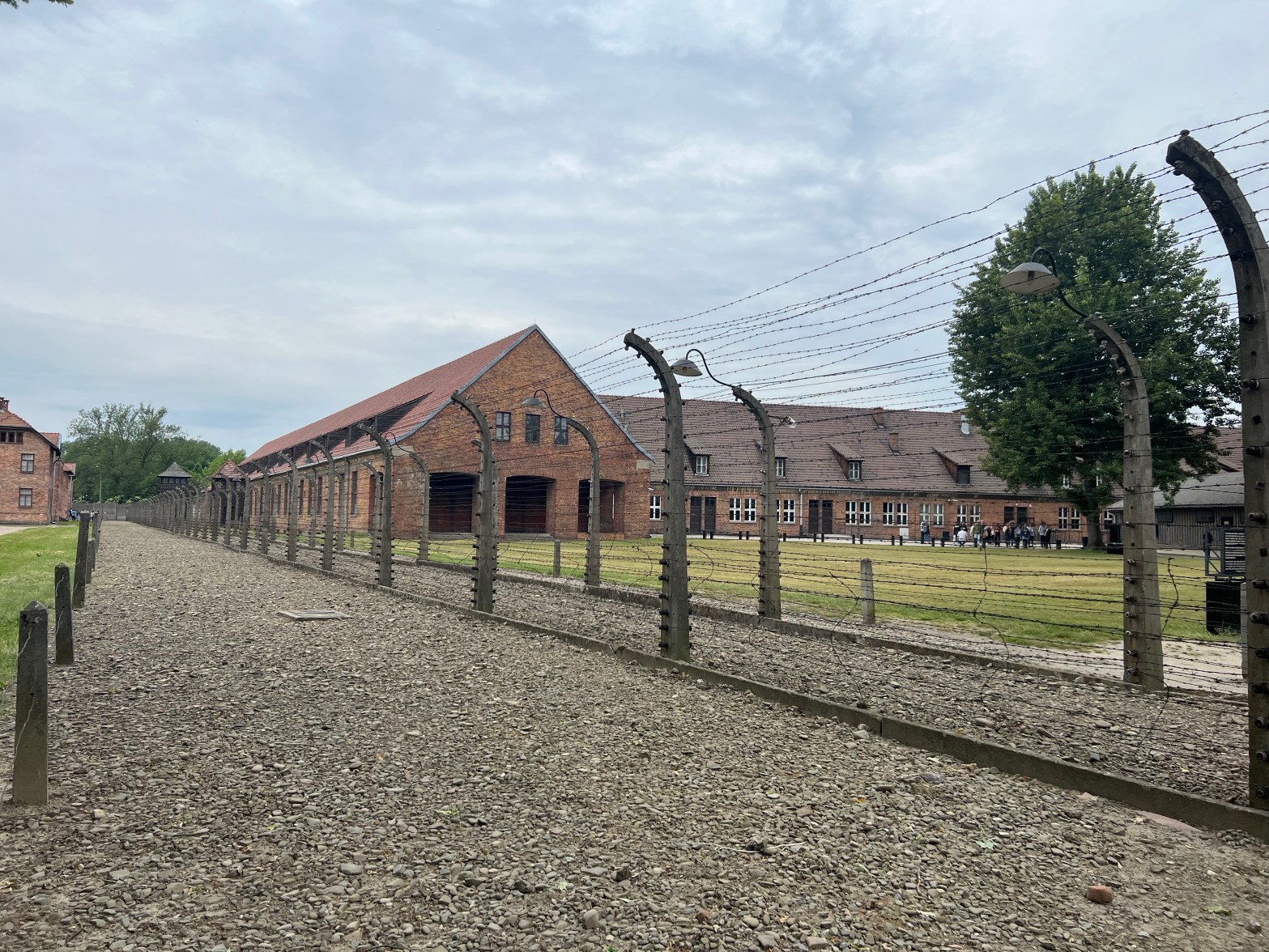
What does it say about our current world, that visitors to Jewish sites in Europe must first pass through metal detectors and have their purses checked? I don’t know what I was expecting, but it wasn’t this. As we left the entrance to join our tour group, the tone of the tour was set – random thoughts prevented any kind of universal understanding. For two hours, the world shrank to the size of details. The famous sign floated over the gate to the camp. We, like so many others, would walk through, but we were lucky enough to do so a second time, on our way out.
Arbeit mach frei.
This slogan was never meant to be taken literally. Work wouldn’t make you free, but punishing toil would keep you alive, at least for a time. Those unable to provide service were sent off in a different direction, to stand under a shower that dispensed Zyklon-B. The gas was originally conceived of as insecticide, but no doubt the Nazis saw no difference between mosquitos and those they considered unfit to continue living. Those bodies they considered untermenschen – sub-human.
This is the only way to understand any of the camps: these were the Nazi equivalent of animal shelters. It’s important to remember this, to understand World War Two was about more than regaining Germany’s honor in the aftermath of World War One. The Nazis believed in slave labor, ethnic cleansing, and genocide. No matter what was done to Germany, and no matter who was to blame, the cure was worse than the disease.
It’s so easy to slip into clichés when talking about the Holocaust. It’s harder to walk in and out of the buildings. Our docent told us that it was usually okay to take photos. One of the exceptions was an exhibit of human hair harvested after the owners were murdered. Another was of gold extracted from human teeth. The docent relayed this information to us using a matter-of-fact tone. How else does one talk about crimes on this sort of scale? How can I even write about this sanely?
Where is the yoga in a pile of shoes torn off the feet of those gassed for their religion? In a separate pile of baby shoes?
Bernie Glassman, a Jewish teacher of Zen Buddhism, leads retreats that take place at Auschwitz. Why? “There is a part of us,” he explains in an interview, “that allows us to dehumanize people. It’s an aspect of ourselves that we don’t want to touch. Auschwitz is the world-monument of that aspect.”
I was, of course, expecting a memorial, something on the nature of the Anne Frank House, or the Homomonument next to the Secret Annexe. (While the biggest number of victims were Jewish, it’s important to remember that the Nazis also murdered Jehovah’s Witnesses, people with disabilities, gays, lesbians, and people of Romany heritage.) That isn’t what I witnessed at Auschwitz. Instead, I saw what Hannah Arendt termed ‘the banality of evil,’ actions so criminal that even the little details horrify.
According to genocide scholar Gregory H. Stanton, there are ten steps that lead to genocide. The first is dividing the world into “us” and “them.” From there, societies progress through hate speech and discrimination into acts of violence and murder writ large. The last step, of course, is always denial. When confronted with evidence, the perpetrators resort to a type of behavior horribly and appropriately termed gaslighting.
Which brings us back to the question: where is yoga in such history? In the confrontation, perhaps. In the simple assertion that this happened, that this kind of sin potentially exists in all of us. When we walk by a homeless person without looking, we deny humanity. When we call certain people “illegal,” we do the same. When we confront our own prejudices, we stop the cycle on a personal level. Patanjali calls this svadyaya, or self-examination.
Of course, reacting on a personal level isn’t nearly enough. Coming to yoga through a Tantric lens, I learned that one doesn’t need to renounce the world and live in a cave to connect with God, that one can do this while being a householder, a member of society, a parent, a friend. I tie this to the Jewish teaching of tikkam olam, or healing the world. If everyone and everything is sacred, then it’s all worth fighting for. We begin with the Hippocratic Oath: first, do no harm. After that, it’s important to speak up and do what’s necessary to prevent the events of the Holocaust from repeating themselves.
I was at Auschwitz nine days ago. I haven’t fully assimilated the experience. But when I come to my mat and set my intentions, I remember that this isn’t just about me anymore, that it never has been. Each of us has an obligation to the rest of the world. Whether we are cancer researchers or caring friends, our actions affect the world around us. Yoga gives us so many gifts, and we in turn must pass them on to the rest of the world. I can’t do everything, but I can do something – in the time I’ve been home, I’ve so far read a banned book, connected with friends, and written this blog post. Every day gives us reasons to take our practice off the mat and into the world. Whether through social change or by being good to those around us, we are responsible for creating the world we want to experience.
I welcome your thoughts and comments.
 Yoga Cielo Stellato