
Human Kinetics Press specializes in book that focus on athleticism and science, and the publishing company has long made good on explaining the physical dynamics of yoga. Yoga Anatomy, which has sold more than a million copies, is now in its third edition. Originally written by Leslie Kaminoff, the later versions have added Amy Matthews as a second author, and have expanded and updated the first edition — which was pretty amazing in and of itself. My version is dated 2007, and I’ve found it to be an excellent explanation of why and how yoga gets and keeps the human body in shape.
The first edition begins by discussing the way that yoga impacts the breath and the spine. If you’ve never thought about the anatomical demands of breathing, you’ll be amazed at the complexity of the human body. You’ll be less surprised by the anatomy of the spine, but in both cases, you’ll appreciate understanding the biological basis for yoga. The writing is terse enough that it’s easy to follow, but goes into enough detail to make the science understandable. Whether or not you have a background in dance or medicine, you’ll find the explanations here coherent. Keep in mind, however, that this book is not written for a general audience; the narration should be read slowly and perhaps twice or three times in order for you to learn the material. Kaminoff’s tone is both scientific and professional, and some might find it dry.
From this initial discussion, the book divides into sections focused on different groups of asanas. Each listed pose is then given an anatomical diagram, a short explanation of the joints and muscles involved, how to integrate breathing into the movement, and notes on the obstacles that must be faced in moving in and out of each pose. This last section is extremely important, as there is discussion of possible injuries that can occur if proper alignment is not stressed.
Kaminoff assumes that readers have prior knowledge of the poses, giving no information on moving in and out of each posture or on modifications. Most of the book can be thought of as an anatomical encyclopedia of yoga, best used as a reference. In tandem with your at-home practice, it will provide insight into the eternal question: how can a pose look so simple but be so difficult to achieve? Answers are here if you’re willing to study them.
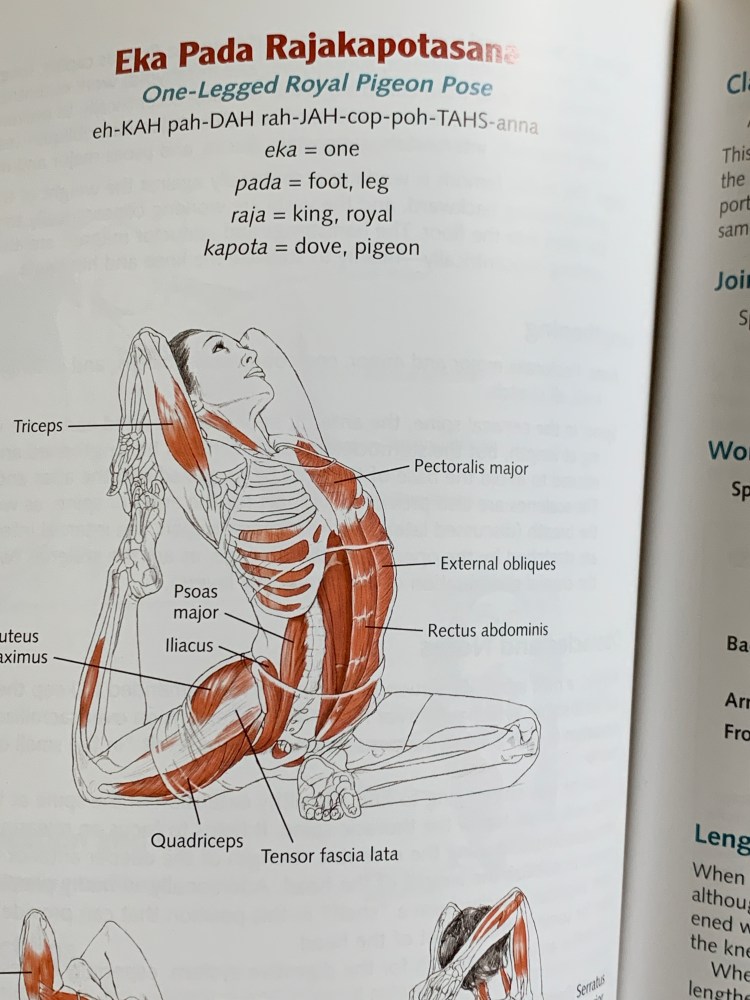
The artwork, at least in my edition, is stunning. Rather than use photography, medical illustrations by Sharon Ellis clearly depict the muscles involved in each asana, and, where needed, the way in which the muscles interact with tendons, joints, and bones. Color is used simply but with great impact to distinguish working muscles from those that are more inert.
This tome is an excellent reference to have on hand when reviewing a particular yoga sequence. I recommend it for seasoned yogi/nis, for those taking a yoga teacher training, and those interested in writing about yoga.
Disclaimer: I paid for my copy of this book with my own funds. I am not in any way associated with the author or with the publishing company.
 Yoga Cielo Stellato