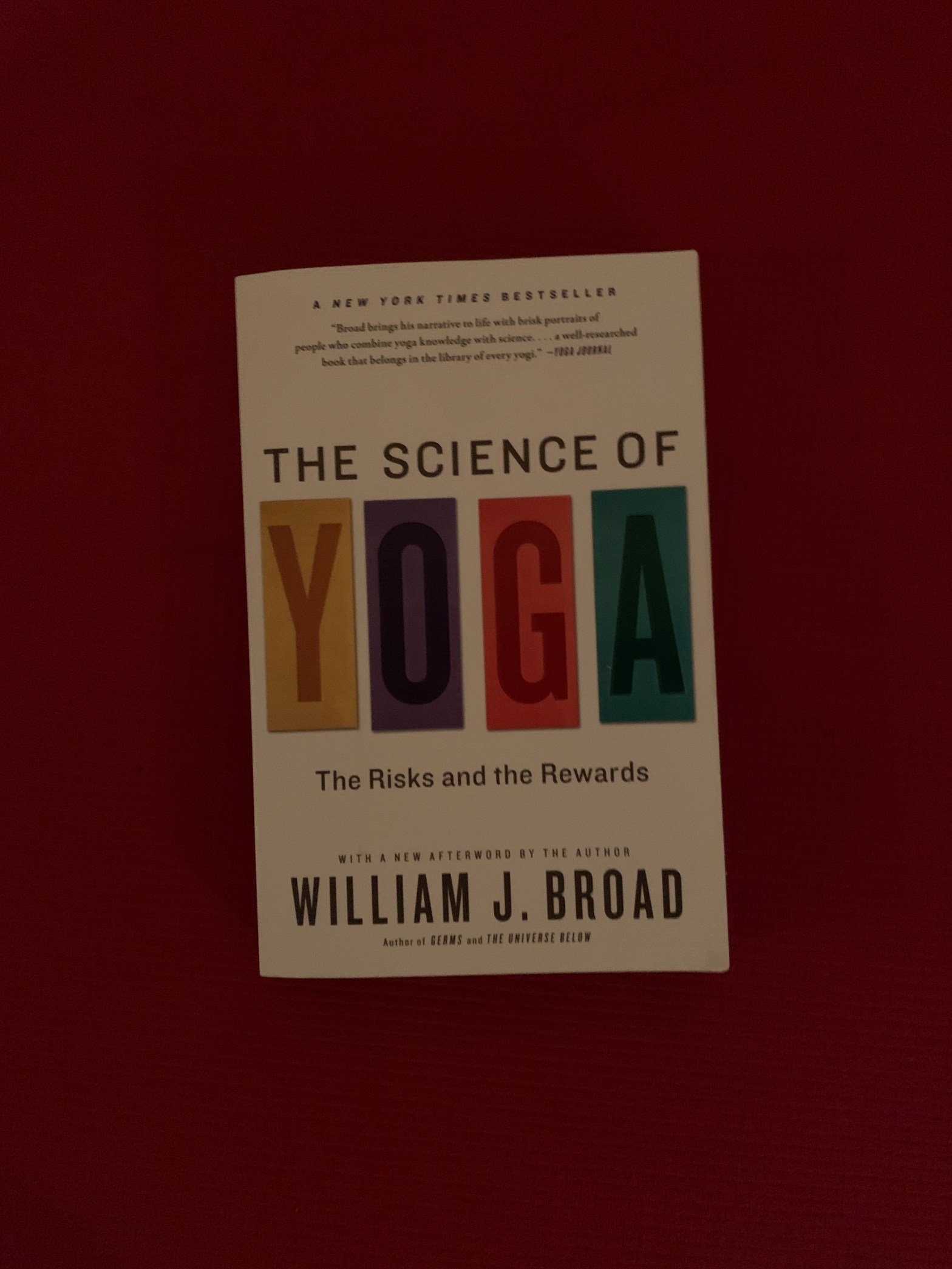
Proponents of yoga make many claims as to the efficacy of the practice. For some, belief is enough; for skeptics, however, there are questions about what yoga can actually accomplish. If you’re curious about the scientific effects of yoga on the human body and mind, you would do well to read The Science of Yoga: the Risks and the Rewards, written by William J. Broad, a journalist and yogi.
Rather than blindly accepting widely touted ideas about what yoga can and cannot do, Broad set out to research the medical studies on yoga. In addition to extensive reading of both classical and contemporary works on the discipline, he consulted a variety of scientists, psychologists, and yoga teachers. The Science of Yoga is therefore a kind of meta-study, examining a number of claims from both a historical and a modern perspective.
This is not a how-to book; while there are illustrations of certain poses, you’re not going to find information on alignment or the minutiae of practice. Instead, you’ll discover a discussion of yoga that focuses on the scientific studies of various health and psychological claims. For example, Broad reviews the research of yoga as a vehicle for providing cardiovascular fitness, an idea vigorously debated by the fitness industry. He finds that the question is much more complicated than it seems, and in the process also scrutinizes whether or not yoga provides a complete physical fitness practice in and of itself. In addition, he looks at another hot button topic, the question of whether yoga aids weight loss. Broad’s discussion underscores that “yes” or “no” answers are in fact oversimplifications of a complicated issue.
Beyond the claims for yoga as valid exercise, Broad examines the scientific evidence for yoga as an enhancer of emotional and creative well-being. Here, scientific scrutiny seems to find more evidence for yoga’s power to enhance such areas as creativity and mood stabilization. Again, however, he makes clear that there is a great deal that’s not yet completely understood. Science isn’t sure how exactly yoga works to improve one’s welfare, and one should investigate all blanket claims thoroughly before accepting anything as gospel truth.
This tome has received fame for Broad’s seminal examination of the risks of injury inherent in yoga practice. If you read only only chapter carefully and slowly, make it this one! Perhaps the biggest value of this work is how it challenges the commonly publicized idea of yoga as completely safe. Broad aptly reminds us that we must stay personally responsible for our own well-being, tempering every asana to an appropriate level for our current physical state.
While Broad’s style is easy to read, he covers quite a bit of material. Delving into various subtopics in depth produces a complex study that cannot be read and absorbed in a single sitting or two. It might be better to consider this book as a kind of encyclopedia of scientific yoga studies, written for the layman. The table of contents is organized by claim (“Moods”, “Risk of Injury”, “Muse”, etc), allowing us to jump between chapters and focus on specic areas of interest. Be forewarned, however: if you’re committed to a personal yoga practice, you’ll probably end up eventually reading the book from cover to cover. Published in 2012, the book is due for an update; I hope to see a second edition out soon.
Broad, William J. The Science of Yoga: the Risks and the Rewards. Simon and Schuster Paperbacks, New York, New York. 2012. ISBN: 978-1-4516-4143-1
Disclaimer: I purchased this book with my own funds and have no connection to the writer. The opinions discussed above are my own.
 Yoga Cielo Stellato